
Where Are We Headed? What the Evidence Suggests About Food in 2050

Key Takeaways
The plant-based food market has not collapsed; it is sorting itself out. Growth is uneven by category and region.
Meat mimicry looks increasingly like a niche, not the main event. The bigger long-run opportunity may be plant-based foods that do not apologize for not being meat.
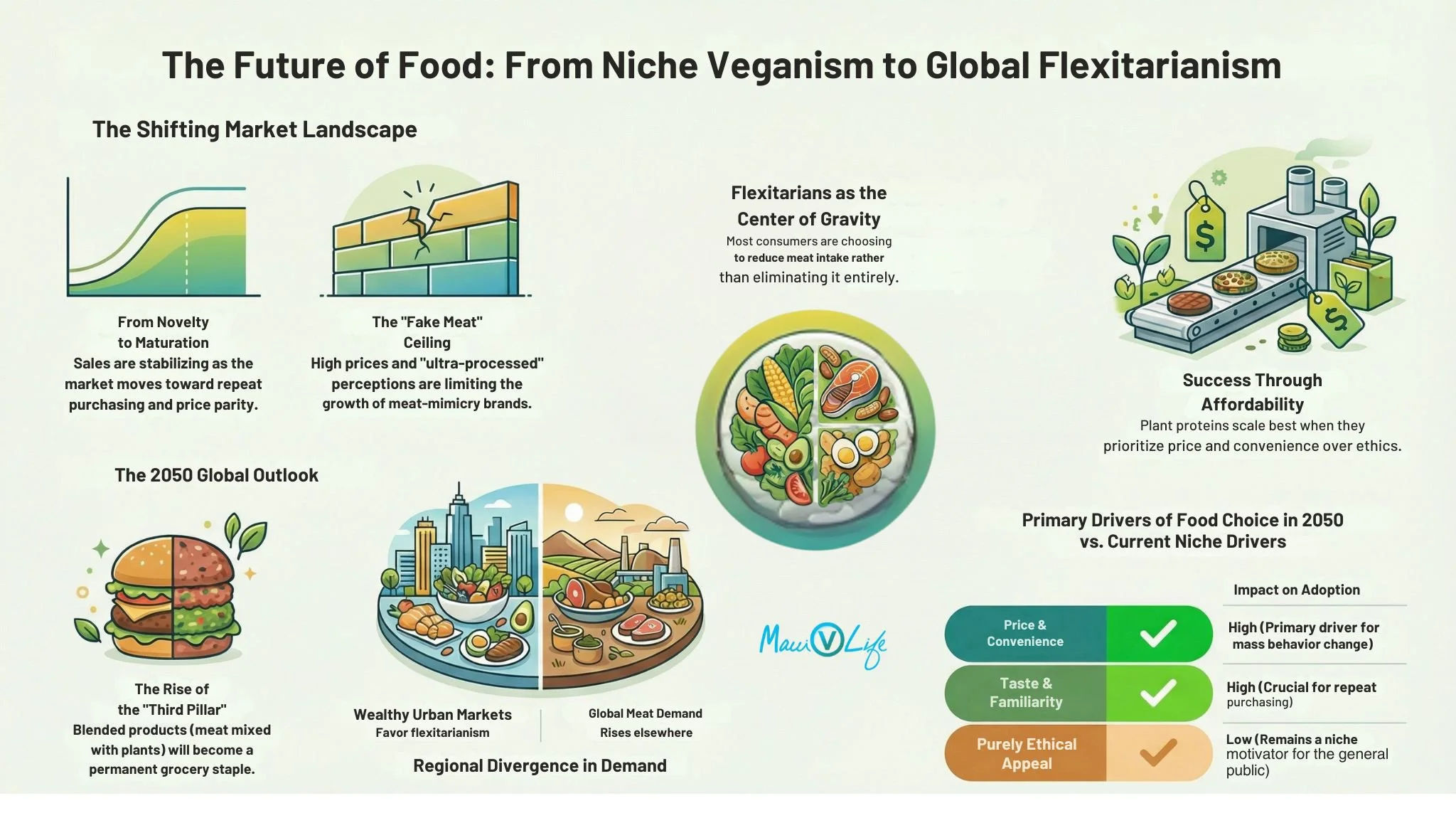
“Blended” meat may have caught on. Some food producers are moving toward "hybrid" products of meat and plants that appeal to consumers who want to reduce their environmental footprint without giving up meat.
Growing flexitarianism is real. Many people are reducing meat, and fewer are eliminating it.
Global meat consumption is rising overall, mainly driven by growth in Asia, Africa, and Latin America.
By 2050, people from wealthy and urban regions will consume less meat, more often, and plant proteins will play a bigger role globally, including hybrid products.
Vegans concerned by farmed animal cruelty and climate change should support large-scale initiatives to increase the availability of affordable, appealing and nutritious vegan food worldwide.
——————————————————-
Appalled by needless animal suffering and alarmed by climate change, many of us want to see a 100% shift from animal agriculture to plant-based agriculture today. Unfortunately, vegans do not have the numbers to bring about radical change.
So let’s talk strategy, not wishful thinking.
Maybe you eat a balanced whole food plant-based (WFPB) diet. This is the best diet for optimal health, reducing farmed animal cruelty and advancing environmental sustainability. You never eat fake meat, so why should you care about the struggles of the latest fake burger brand?
Because to reduce farmed animal suffering and greenhouse gas emissions on a scale that matters, billions of non-vegans must gain greater access to affordable and convenient animal-free proteins that they will actually buy, cook, and reorder, not what we think they should eat. An estimated 40% of the world’s population obtains food from grocery stores, restaurants, convenience stores and foodservice. Few embrace WFPB eating. Corporate vegan products that may not appeal to us can play a huge role in reducing worldwide meat consumption.

The Plant-Based Market Hasn’t Collapsed
Headlines love drama like “veganism is dying.” What is actually happening is the plant-based food market is moving from novelty to repeat purchasing. That is what “maturing” looks like.
In Europe, recent retail data show plant-based food sales value holding steady or rising modestly, while volume can rise even when value growth slows because prices are falling, often due to private-label competition. This is the part advocates should care about because price parity is one of the few levers that reliably changes mass behavior.
Meanwhile, some categories are simply sturdier than others. Plant milks, tofu and legumes often behave differently than plant-based meat analogues because they are less dependent on “does it taste exactly like meat?” comparisons.
Why Plant-Based Meat Feels Stuck
Recent reporting out of Singapore and broader industry commentary is consistent on the four main headwinds: Price premiums are still hard to justify. Taste expectations are brutal. The “ultra-processed” perception is growing. Nutrition is mixed, and consumers are catching on.
None of this means plant-based meat disappears. It means it behaves like a category with a ceiling unless it improves materially on price, taste, and nutrition.
“Blended” Meat May Be Here to Stay
Some food producers are moving toward "hybrid" products (e.g., a burger that is 70% beef and 30% mushroom or pea protein). This is becoming a "middle ground" for consumers who want to reduce their environmental footprint without giving up meat entirely. Analysts and food scientists predict that blended meat will become a permanent, "third pillar" of the meat aisle, alongside traditional meat and fully plant-based meats. Some experts also feel that “cultivated” or lab-grown meat may emerge as a major component of hybrid meat-plant products.
Flexitarians are the Center of Gravity
Many people are eating less meat. Few are becoming vegan. The Vegan Society’s 2025 cross-country work found flexitarian identification meaningfully present across countries, but not at the “nearly half of the world” level often claimed in casual internet summaries.
This is still a huge cultural shift, but we should be careful with oversimplified stats.
Flexitarians don’t necessarily want fake meat. A growing share seeks “vegetable-forward” meals, traditional plant proteins, and foods that feel familiar without pretending to be animal meat. That point, central to the FoodNavigator argument, is that “meat alternatives are niche,” while broader plant-based foods have more runway.
Meat Grows Globally, Even as Alternatives Expand
The Organization for Economic Co-operation and Development and the Food and Agricultural Organization of the UN (OECD-FAO) outlook continues to project overall growth in global animal protein demand over the next decade, with the strongest growth coming from emerging and middle-income regions. More plant-based options and more flexitarian behavior will occur in wealthy, urban markets, while total meat consumption increases globally as incomes rise elsewhere. This tension is exactly why “niche but growing” is a plausible description of plant-based meat analogues, even in a world where plant proteins overall gain ground.
Food 2050
Predictions are tricky, but the best evidence points to:
High-income and urban middle-class markets are drifting toward flexitarian norms. Meat becomes less central, not absent.
Plant proteins grow most reliably when they win on price, convenience, and familiarity, not just ethics.
Plant-based meat analogues remain important, but they are not the single highway to a protein transition.
Traditional plant-based foods and ingredients scale better than “perfect meat mimicry,” and the industry is already diversifying in that direction.
Regulators and institutions will push for better nutrition standards, which may slowly raise the floor on formulation quality.
Innovation continues (high-moisture extrusion, new protein sources, better textures), but this will not translate into mainstream adoption of plant-based meat without affordability.
Conclusion
The best available evidence suggests that 2050 is much more likely to be flexitarian than vegan. Why should we be “flexible” in the face of animal cruelty and environmental destruction? A flexitarian world is morally unsatisfactory, but it is also not nothing. Vegans can make a real difference by supporting efforts to make affordable, minimally processed, and appealing vegan food available to billions of consumers who may never fully embrace WFPB but are receptive to change.
14 Organizations Working to Increase Plant-Based Food Options
A Well-Fed World
Strengthens global food security through plant-based hunger relief and farming programs while advocating for a transition away from animal agriculture in marginalized communities.
Better Food Foundation
US-based nonprofit that advances “plant-based by default” meal policies in institutions (universities, cities, events, faith communities), shifting catering and foodservice toward plant-based choices.
Chilis on Wheels
Makes veganism accessible to low-income communities through meal shares, educational workshops, and mentorship programs across multiple U.S. cities and Puerto Rico.
Community Solidarity
Operates America's largest vegetarian hunger relief program, distributing over seven million pounds of vegetarian groceries and hot vegan meals annually to families across Long Island and NYC.
Food Empowerment Project
Creates a more just food system by promoting veganism, addressing lack of access to healthy foods in low-income areas, and advocating for farm workers' rights.
Food Yoga International (formerly Food for Life Global)
Operates a network of over 250 affiliate projects in 65 countries serving over 1 million plant-based meals daily to address hunger and food insecurity through vegan meal distribution.
Mercy For Animals
Works to end industrial animal agriculture by promoting plant-based foods through corporate policy changes and institutional programs, having helped serve over 35 million vegan meals in schools globally.
Plant Based Treaty
International campaign and nonprofit initiative pushing governments and cities to commit to a transition to plant-based food systems as a climate solution
ProVeg International
Works to replace 50% of animal products globally with plant-based and cultivated foods by 2040 through policy advocacy, corporate partnerships, and institutional programs across 14 countries.
Support + Feed
Tackles food insecurity and advocates for an equitable plant-based food system by partnering with plant-based restaurants to provide meals to people in need nationwide
The Good Food Institute
Accelerates the development and advancement of plant-based and cell-based meat, eggs, and dairy to make alternative proteins more accessible and affordable worldwide. (“Lab-grown” meat, eggs and dairy are not vegan, and many vegans are understandably not interested in consuming these products. However, mass consumption of “cultivated” meat, eggs and dairy could prevent the suffering and deaths of billions of farmed animals.)
The Humane League
Global farmed-animal organization best known for corporate campaigns, but also runs vegan advocacy and education programs via Humane League Labs and grassroots outreach.
Vegan Outreach
Ends violence towards animals by promoting plant-based eating through massive outreach programs including its 10 Weeks to Vegan challenge in 18 countries, with over 1.7 million sign-ups.
Veganuary
A global nonprofit that runs the annual “try vegan in January” pledge, with around 30 million people estimated to have taken part in the 2026 campaign across 20 countries.
Sources
Veganism Around the World 2025, The Vegan Society
https://www.vegansociety.com/sites/default/files/uploads/downloads/Veganism_Around_the_World_2025_%20The_Vegan_Society.pdf
Plant-based retail sales in six European countries, GFI Europe
https://gfieurope.org/european-plant-based-sales-data/
OECD-FAO Agricultural Outlook 2025-2034
https://www.oecd.org/en/publications/oecd-fao-agricultural-outlook-2025-2034_601276cd-en.html
ProVeg: Understanding consumer demand for plant-based options in foodservice
https://proveg.org/article/understanding-consumer-demand-for-plant-based-options-in-foodservice/
Vita Mojo: QSR consumer eating and drinking trends (UK, 2024)
https://www.vitamojo.com/blog/qsr-consumer-eating-and-drinking-trends/
CNA: Is plant-based meat healthy? What you need to know
https://www.channelnewsasia.com/today/ground-up/plant-based-meat-healthy-what-you-need-know-consumer-4634836
CNA: Restaurants drop plant-based meats, citing high costs, low demand
https://www.channelnewsasia.com/today/ground-up/plant-based-meat-popularity-waned-5909426
FoodNavigator: Meat alternatives are too niche, plant-based can do so much more
https://www.foodnavigator.com/Article/2026/02/06/meat-alternatives-are-a-niche-product-but-plant-based-could-have-a-future/
Singapore Health Promotion Board: Healthier Choice Symbol nutrient guidelines (July 2025 revision)
https://www.hpb.gov.sg/docs/default-source/pdf/hcs-guidelines-revision-july-2025.pdf?sfvrsn=85ed0979_3
Singapore Institute of Technology: Industry Alignment Fund testbed platform for plant-based proteins
https://www.singaporetech.edu.sg/openhouse2025/news/singapore-food-story-grant-awarded-sit-future-foods
IMCD press release: partnership with SGProtein on high-moisture meat analogues
https://www.imcdgroup.com/media-centre/press-releases/20220328-imcd-partners-with-sgprotein-to-innovate-on-plant-based-concepts-with-MC5NJWPFYB6BEZDCCBKWYQUBAPOY